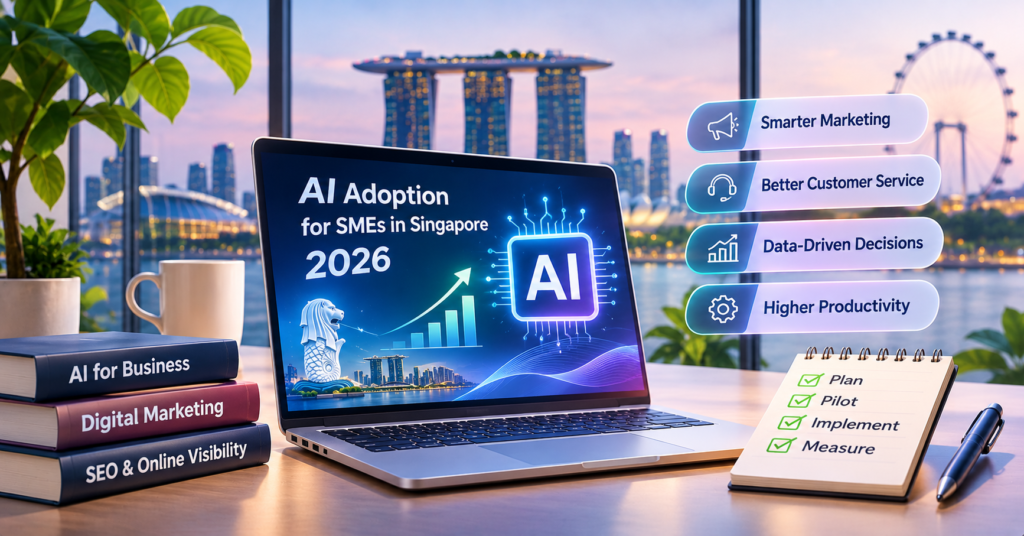
Artificial intelligence (AI) is becoming an important part of how Singapore businesses operate. From managing customer enquiries to preparing marketing content and analysing business information, AI offers opportunities to improve efficiency without necessarily expanding a company’s workforce.
However, AI adoption in Singapore is not simply about purchasing new software. Small and medium-sized enterprises (SMEs) need to understand which applications are useful, what challenges they may face and how to measure the benefits.
For businesses exploring AI in 2026, the priority should be solving genuine operational problems rather than following every emerging technology trend. This guide explains the current adoption landscape, practical applications, available support and steps Singapore SMEs can take to introduce AI responsibly.
What Is AI Adoption and Why Does It Matter for Singapore SMEs?
AI adoption refers to using artificial intelligence technologies to support or improve business activities. These technologies may include generative AI assistants, automated customer support systems, predictive analytics and AI-enabled business software.
For smaller businesses, AI can help reduce repetitive work, organise information and support decision-making. For example, a Singapore retailer might use AI to categorise customer enquiries, while a digital marketing team could use it to prepare initial content outlines. The benefits depend on selecting suitable applications and maintaining appropriate human oversight.
AI Adoption in Singapore: What the Latest Figures Show
Singapore’s Infocomm Media Development Authority (IMDA) reported that AI adoption among SMEs increased from 4.2% in 2023 to 14.5% in 2024. More recent figures cited in Singapore’s 2026 AI adoption reporting indicate that the SME adoption rate reached 23.4% in 2025.
These figures suggest that more businesses are experimenting with AI, although adoption remains uneven across organisations. Importantly, using an AI writing assistant occasionally is different from integrating AI into daily operations.
A company may generate marketing captions with AI while continuing to manage enquiries, reporting and internal processes manually. The next challenge for SMEs is therefore moving from experimentation towards applications that deliver measurable business value.
How Can Singapore SMEs Use AI in Their Business?
AI can support different business functions, but the most suitable applications depend on the company’s requirements.
1. Content Creation and Digital Marketing
AI tools can assist with brainstorming, keyword organisation, content outlines and initial marketing drafts. For example, an eCommerce business could use AI to prepare product description drafts before reviewing specifications, pricing and product benefits.
However, publishing unverified AI-generated content may introduce inaccuracies and weaken customer trust. Businesses should prioritise helpful website content creation supported by human expertise rather than simply increasing publishing volume.
2. Customer Service and Enquiry Management
AI-powered chatbots can help businesses respond to frequently asked questions, provide basic service information and direct enquiries to appropriate teams. For example, a tuition centre could use a chatbot to answer questions about operating hours, programme availability and registration procedures. Complex enquiries should still be directed to qualified staff. Businesses must also ensure that customer-facing AI systems provide accurate information and handle personal data appropriately.
3. Business Reporting and Data Analysis
AI-enabled reporting tools can help businesses organise information, identify patterns and summarise performance. A retailer might analyse purchasing trends, while a marketing team could review campaign data to identify areas requiring attention. However, AI-generated interpretations should be checked against reliable data before business decisions are made.
4. Administrative Tasks and Workflow Automation
Repetitive activities such as document classification, meeting summaries and internal information retrieval may be suitable for AI assistance. Businesses should first identify which processes consume significant time and whether automation would genuinely improve them. Not every task requires an AI solution.
How AI Is Changing SEO and Online Business Visibility
AI adoption is also influencing how businesses approach digital marketing and customer discovery. Search experiences increasingly include AI-generated explanations, summaries and recommendations alongside conventional search results. For Singapore SMEs, this creates opportunities to improve how clearly their businesses are represented online.
AI-Assisted Keyword Research and SEO Analysis
AI can help organise keyword lists, group related search queries and identify possible content gaps. However, AI-generated recommendations should be validated using actual search data, customer intent and website performance. Businesses still need effective on-page SEO strategies to ensure that individual webpages provide relevant information.
Generative Engine Optimisation (GEO)
Generative Engine Optimisation focuses on making information easier for AI-powered search systems to discover, understand and potentially reference. For example, a service page should clearly explain what a business offers, who it serves, where it operates and what distinguishes its services. Accurate information, descriptive headings and relevant supporting evidence can improve content clarity. Businesses exploring generative engine optimisation strategies should understand that no method guarantees AI citations or recommendations.
Website Experience and Technical Readiness
AI-powered marketing cannot compensate for a website that is difficult to navigate or contains outdated information. Before introducing advanced tools, businesses should review mobile usability, loading performance, service descriptions and enquiry forms. Addressing website performance and usability may provide more immediate value than adding unnecessary AI features.
What Challenges Do SMEs Face When Adopting AI?
Although AI offers potential advantages, businesses should evaluate implementation risks before committing resources.
Limited Technical Knowledge
Employees may be unfamiliar with AI tools or unsure how to use them effectively. Training and clear internal guidelines can help teams understand appropriate applications and limitations.
Implementation and Subscription Costs
AI tools may involve subscription charges, integration expenses and staff training costs. Businesses should assess the total cost rather than considering only introductory offers or free trials.
Data Privacy and Security
AI systems may process customer information, business records or confidential documents. Singapore businesses must consider their obligations under the Personal Data Protection Act (PDPA) and applicable guidance from the Personal Data Protection Commission. Sensitive information should not be entered into external AI tools without appropriate authorisation and safeguards.
Accuracy and Overdependence
AI-generated information can contain factual errors, outdated details or misleading conclusions.
Businesses should establish review procedures, particularly for financial, legal, healthcare and customer-facing information. Human accountability remains essential.
What Government Support Is Available for AI Adoption in Singapore?
Singapore provides several initiatives to help businesses strengthen their digital capabilities.
SMEs Go Digital Programme
IMDA’s SMEs Go Digital initiative helps businesses explore suitable digital solutions, including AI-enabled applications. Available resources include industry-specific guidance, curated solutions and information about applicable support schemes. Eligibility and funding conditions vary by solution.
National AI Impact Programme
Introduced in March 2026, the National AI Impact Programme aims to help 10,000 enterprises advance their AI adoption over three years. The initiative supports Singapore’s wider efforts to strengthen business capabilities and workforce readiness.
AI for Enterprise Impact Playbook
Developed by IMDA, SkillsFuture Singapore and Workforce Singapore, this playbook helps businesses assess AI readiness and identify relevant next steps. It covers areas such as leadership, workforce skills, data governance, technology integration and business value. SMEs should review official programme information before making financial commitments, as participation requirements and support arrangements may change.
How to Start AI Adoption: A Five-Step Approach for SMEs
Businesses do not need to implement several AI solutions simultaneously. A focused approach makes it easier to evaluate costs, risks and outcomes.
Step 1: Identify a Specific Business Problem
Start with an existing challenge, such as slow customer response times, repetitive reporting or time-consuming content preparation. Define the problem before selecting software.
Step 2: Assess Your Current Processes
Review existing workflows, employee capabilities and available data. Some problems may be resolved through clearer procedures or website improvements without introducing AI.
Step 3: Select One Suitable AI Application
Choose a tool that addresses the identified problem. Compare functionality, security, costs, integration requirements and available support.
Step 4: Conduct a Small Pilot
Test the application with a limited group of employees or a defined business process. Establish clear review procedures and provide relevant training.
Step 5: Measure Results Before Expanding
Evaluate whether the pilot improved efficiency, accuracy or customer experience. Only expand implementation when the benefits justify the costs and operational requirements.
How Can SMEs Measure the Success of AI Adoption?
AI adoption should be assessed using meaningful business outcomes rather than the number of tools introduced.
Business Area
Suggested Performance Indicator
Customer service
Response time and enquiry resolution
Content marketing
Production efficiency and content accuracy
Sales
Qualified enquiries and conversion rates
Operations
Time saved on repetitive tasks
Website experience
Engagement and completed enquiries
Financial performance
Implementation costs and measurable savings
For example, an SME introducing AI-assisted content preparation should compare the time required to produce and review content before and after implementation. It should also assess whether accuracy and usefulness have been maintained. The objective is sustainable improvement, not automation for its own sake.
Final Thoughts: Making AI Adoption Work for Singapore SMEs
AI adoption in Singapore is creating new opportunities for SMEs to improve productivity, customer engagement and digital operations. However, successful implementation depends on choosing appropriate applications, preparing employees and evaluating results. Businesses should begin with manageable improvements rather than adopting multiple tools without a clear purpose. For digital marketing, AI can support research, content development and performance analysis, but a strong website and effective search strategy remain essential.
Strengthen Your Digital Presence with SEOCompany.me
At SEOCompany.me, we help Singapore businesses improve their online visibility through search optimisation, technical improvements and AI-focused search strategies. Whether your business is exploring AI-powered search or reviewing its existing digital presence, we can help identify relevant optimisation opportunities. Request a Free SEO Consultation to discuss your business goals.
Frequently Asked Questions About AI Adoption in Singapore
1. Is AI adoption suitable for small businesses in Singapore?
Yes. Small businesses can explore AI applications for customer enquiries, administrative work and marketing. They should begin with affordable solutions that address genuine business requirements.
2. How much does AI adoption cost for SMEs?
Costs depend on the software, number of users, integration requirements and training involved. Some programmes offer trials or support, but businesses should review ongoing subscription and implementation expenses.
3. Are there government grants for AI adoption in Singapore?
Certain AI-enabled solutions may qualify for government support, subject to applicable programme conditions. SMEs should check official IMDA and Enterprise Singapore resources for current eligibility requirements.
4. Can AI improve SEO results?
AI can support keyword analysis, content planning and reporting. However, better rankings depend on content relevance, website quality, competition and other search factors. AI tools alone cannot guarantee SEO improvements.
5. What should SMEs consider before using AI tools?
Businesses should assess data security, accuracy, employee training, costs and expected outcomes. Human review is especially important when AI handles sensitive information or customer communications.
Jamie is a Digital Marketer with an interest in SEO, content marketing, social media, and online brand growth. Jamie focuses on creating effective digital strategies that help businesses strengthen their online presence and connect with their target audiences.
 Jamie