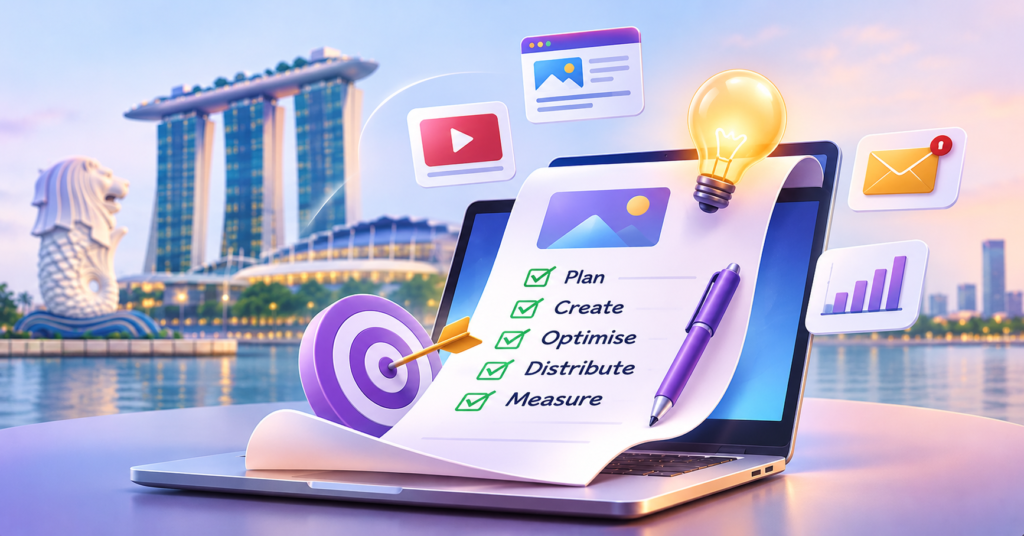
Publishing blogs and social media posts regularly does not automatically bring customers to your business. Without a clear strategy, even well-written content may struggle to reach the right audience. Effective content marketing in Singapore focuses on understanding customer needs and providing useful information throughout their buying journey.
For example, a tuition centre might publish guidance on choosing enrichment programmes, while a renovation company could explain HDB renovation requirements. Both help potential customers make informed decisions while demonstrating their expertise. This guide explores how Singapore businesses can plan, create, optimise and measure content that supports search visibility and business growth.
What Is Content Marketing?
Content marketing involves creating and sharing relevant information to attract, educate and engage a specific audience. Unlike traditional advertising, which primarily promotes products or services, content marketing provides information that helps customers understand their options.
Common formats include blog articles, videos, infographics, case studies, guides and newsletters. For example, a skincare clinic might publish an article explaining different facial treatments before encouraging readers to book a consultation. This approach helps businesses establish credibility before customers make purchasing decisions.
Content Marketing vs Traditional Advertising
Advertising typically involves paying to display promotional messages to potential customers. Content marketing focuses on providing information that people actively seek. Both approaches can complement each other. A business might publish an educational guide to attract organic visitors and promote it through paid campaigns. Content marketing can also support broader search optimisation efforts by addressing relevant customer queries.
Why Is Content Marketing Important for Singapore Businesses?
Singapore customers frequently compare businesses, read reviews and research services before making enquiries. Useful content allows businesses to participate in this decision-making process.
Build Customer Trust
Educational content demonstrates industry knowledge through practical explanations and reliable information. For example, a tuition centre explaining common learning difficulties can help parents understand what to consider when choosing additional academic support. Accurate information and genuine experience build stronger credibility than unsupported promotional claims.
Improve Organic Search Visibility
Relevant content can help businesses appear for informational searches related to their services. A renovation company might target questions about renovation costs, materials or project planning. By answering these questions, businesses can attract visitors who may eventually require their services.
Support Customer Engagement
Content marketing also helps businesses maintain relationships after a purchase. Maintenance guides, tutorials and newsletters provide continuing value. For example, an air-conditioning company could publish seasonal maintenance advice for existing customers.
Different Types of Content Marketing
Businesses should select content formats based on audience preferences, available resources and marketing objectives.
Blog Articles and Educational Guides
Blogs are suitable for explaining topics that require detailed information. Popular formats include how-to guides, comparisons, industry updates and frequently asked questions. Well-organised articles can support organic search visibility when they address genuine search intent.
Case Studies and Customer Experiences
Case studies demonstrate how businesses approach real challenges. A useful case study explains the initial problem, solutions implemented and measurable outcomes. Businesses should include accurate results and avoid exaggerated performance claims.
Videos and Infographics
Videos can demonstrate products, explain processes and simplify complex subjects. Infographics are useful for presenting comparisons, statistics and step-by-step information. Supporting text should accompany important visuals to improve accessibility and provide context.
Social Media and Email Newsletters
Social media helps businesses distribute content and engage with audiences. Email newsletters allow companies to share updates with interested subscribers. For example, a retailer could publish a buying guide on its website and share selected tips through Instagram and email.
How to Develop a Content Marketing Strategy in Singapore
A successful strategy connects audience needs with measurable business objectives.
1. Identify Your Target Audience
Begin by understanding who your customers are and what problems they want to solve. Consider their interests, questions, purchasing behaviour and level of knowledge. A company targeting corporate decision-makers will require different content from a business serving parents or homeowners.
2. Conduct Keyword and Topic Research
Keyword research helps identify what potential customers search for online. However, search volume alone should not determine your content strategy. A specific query such as “office cleaning checklist Singapore” may be more relevant to a commercial cleaning provider than a broad keyword such as “cleaning tips”. Use Google Search Console, customer enquiries and competitor research to identify useful topics. You can further improve relevance through effective on-page SEO practices.
3. Match Content to Search Intent
Customers require different information depending on their buying stage.
Customer Stage
Content Type
Example
Awareness
Educational guides
Common causes of website problems
Consideration
Comparison articles
Comparing website platforms
Decision
Case studies and service pages
SEO agency project results
Retention
Tutorials and newsletters
Website maintenance guidance
Matching content to search intent helps readers find information relevant to their immediate needs.
4. Create a Content Calendar
A content calendar helps organise topics, publication dates and responsibilities. Businesses should prioritise quality over publishing frequency. For smaller companies, two well-researched articles per month may be more manageable than frequent posts produced without proper review. Review existing articles regularly to correct outdated information and identify opportunities for improvement.
How Content Marketing Supports SEO and AI Search
Content marketing and SEO work together to improve website relevance and visibility. However, publishing more content does not automatically produce better rankings.
Create Helpful, People-First Content
Google encourages businesses to prioritise content that genuinely benefits readers. Useful content should demonstrate relevant experience, expertise and accuracy.
Businesses can strengthen credibility by including:
Real examples and practical explanations.
Accurate supporting information.
Relevant author details.
Updated facts and references.
Clear answers to customer questions.
Avoid publishing generic information that adds little value beyond existing search results.
Strengthen Internal Linking
Internal links connect related webpages and help visitors discover additional information. For example, a website optimisation guide might link to articles explaining technical issues, mobile usability and structured data. Businesses can direct readers towards common technical website issues when discussing crawlability and indexing. Use descriptive anchor text naturally rather than repeating commercial keywords.
Optimise Content for AI Search
AI-powered search experiences may use information from multiple sources to generate answers. Businesses can make content easier to interpret through descriptive headings, direct explanations and accurate information. For example, a service page should clearly explain what the company offers, who it serves and how customers can make enquiries. Businesses exploring generative engine optimisation strategies should focus on content clarity, credibility and relevance. No optimisation method guarantees inclusion in AI-generated responses.
Implement Relevant Structured Data
Structured data helps search engines understand specific information about webpages. Depending on the content, suitable schema types may include Article, Organisation and BreadcrumbList. Businesses should ensure that markup accurately reflects visible information. Implementing relevant structured data can support clearer interpretation, although it does not guarantee enhanced search appearances.
Content Writing vs Copywriting: What Is the Difference?
Content writing and copywriting serve different purposes. Content writing primarily informs, educates or explains a subject. Copywriting encourages readers to take specific actions, such as requesting a quotation or purchasing a product.
Content Writing
Copywriting
Educational blogs
Promotional landing pages
Informational guides
Product descriptions
Tutorials
Advertising messages
Industry insights
Calls to action
Both can support digital marketing. For example, an educational blog may attract potential customers, while a service page encourages them to make an enquiry. Businesses often require professional website content writing alongside persuasive commercial copy.
How to Distribute Your Content Effectively
Creating useful content is only the beginning. Businesses also need to help relevant audiences discover it.
Repurpose Content Across Channels
A detailed blog can provide material for social media posts, short videos, infographics and newsletters. For example, an article explaining website migration mistakes could become a LinkedIn checklist. Adapt each format to its audience rather than repeating identical content everywhere.
Build Relevant Backlinks
Original research, useful resources and credible case studies may attract references from other websites. Businesses can also share valuable information with industry associations and relevant publications. Focus on earning relevant editorial backlinks rather than purchasing low-quality links.
How to Measure Content Marketing Performance
Content marketing should be evaluated against business objectives rather than traffic alone.
Useful performance indicators include:
Organic clicks and impressions.
Website engagement.
Enquiry form submissions.
Leads generated through content.
Newsletter subscriptions.
Relevant backlinks.
Google Search Console provides information about organic search performance, while Google Analytics can help evaluate visitor behaviour and conversions. For example, a blog generating fewer visits but more qualified enquiries may be more valuable than an article attracting large amounts of irrelevant traffic. Review results regularly and refine content based on actual performance.
Common Content Marketing Mistakes to Avoid
Publishing Without Understanding Your Audience
Content targeting broad, unrelated topics may attract visitors who are unlikely to become customers. Focus on questions relevant to your services and audience.
Keyword Stuffing
Repeating the same keyword excessively can reduce readability. Use relevant terms naturally and prioritise useful explanations.
Creating Duplicate or Overlapping Content
Publishing multiple articles targeting nearly identical search queries can create unnecessary competition between webpages. Review existing content before creating new articles.
Relying Entirely on AI-Generated Content
AI tools can support research, planning and drafting. However, businesses should verify facts, review accuracy and add genuine expertise before publication.
Ignoring Content Updates
Outdated information, broken links and irrelevant examples can reduce usefulness. Regular content audits help identify articles requiring improvement.
Final Thoughts: Make Content Marketing Work for Your Business
Successful content marketing in Singapore requires more than publishing articles regularly.
Businesses need to understand customer questions, create relevant resources, optimise their webpages and evaluate performance.
A structured approach can strengthen organic visibility, build customer confidence and support long-term business objectives.
Need Help Improving Your Content Strategy?
At SEOCompany.me, we help businesses develop search-focused content aligned with customer needs and business goals.
From keyword research and content planning to optimisation, our recommendations focus on creating useful information that supports organic visibility.
Frequently Asked Questions About Content Marketing in Singapore
1. Is content marketing suitable for small businesses?
Yes. Small businesses can begin with a manageable number of helpful articles addressing common customer questions. Relevance and quality matter more than publishing volume.
2. How long does content marketing take to show results?
There is no fixed timeline. Results depend on competition, website condition, content quality and distribution. Organic search improvements may take time to develop.
3. Does content marketing improve SEO?
Content marketing can support SEO by addressing relevant queries, strengthening topical coverage and attracting useful references. However, publishing content does not guarantee higher rankings.
4. Can businesses use AI for content creation?
Yes. AI can assist with outlining and drafting, but businesses should review content for accuracy, originality and usefulness before publishing.
5. How frequently should businesses publish content?
There is no universal frequency. A consistent, manageable schedule that allows proper research and editing is generally more effective than publishing frequently without quality control.
Chloe Tan is an SEO Content Strategist focused on developing content that aligns with search intent and audience needs. She has a keen interest in keyword research, content planning, on-page SEO, and emerging search trends. Chloe combines content strategy with SEO best practices to create useful resources that improve search visibility and audience engagement.
 Chloe Tan